Gojiraf: Building a live shopping SaaS.
Gojiraf
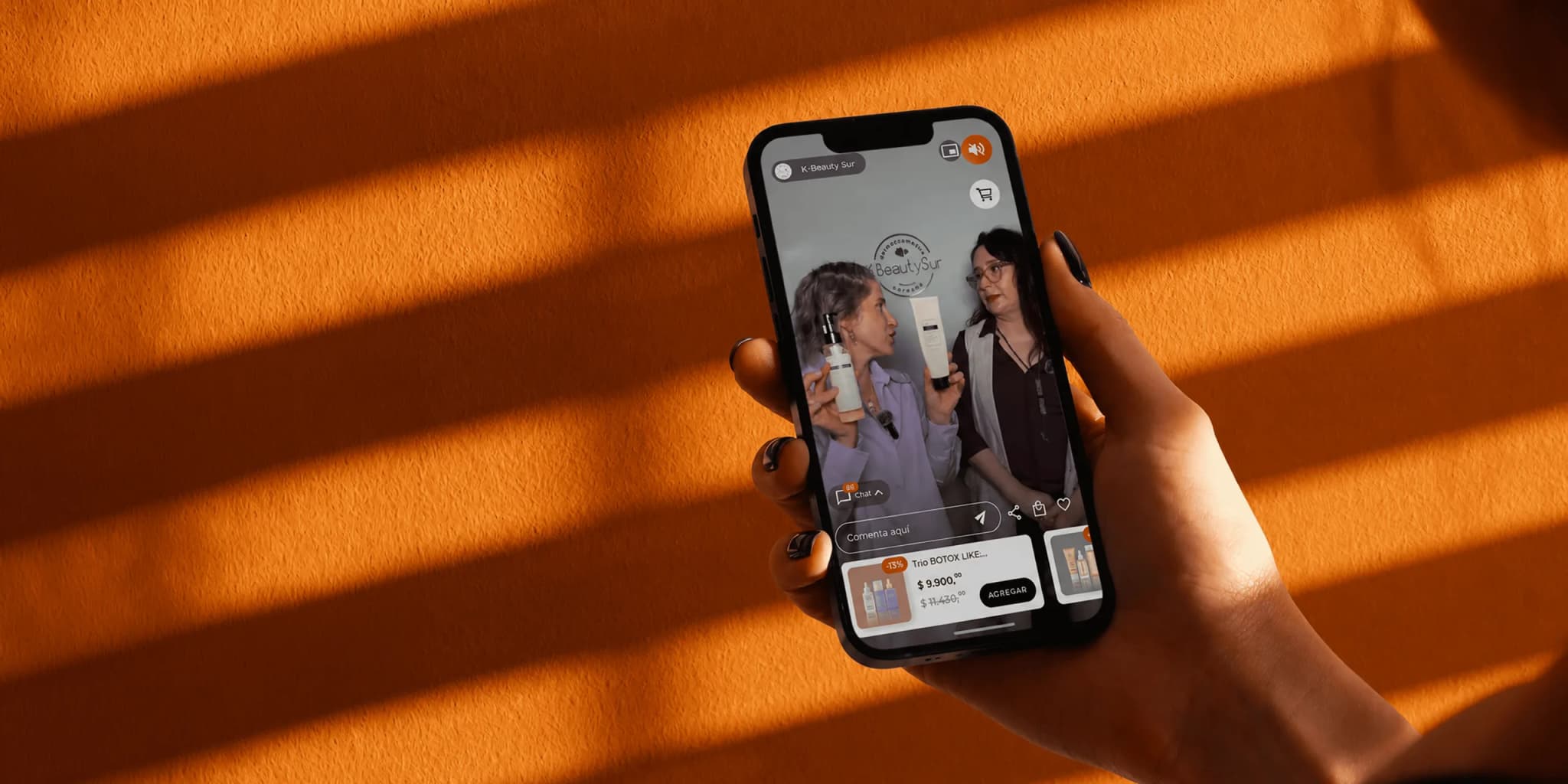
Work done in collaboration with Border Agency and Paisanos.Gojiraf is one of LATAM's most established live shopping platforms. The idea is simple: turn any ecommerce site into a live sales channel, with video, chat, and real-time product integration. My role was to lead a full discovery, audit the existing platform, and design a Wizard of Oz prototype to validate the core hypotheses before committing to building the entire autonomous product.
Company
GoJiraf
Year
2026
Role
Lead Designer (Paisanos + Border)
Human team vs. scaling
Live shopping generates billions of dollars a year in Asia, but in LATAM it's still building its audience and its operators. Gojiraf grew alongside that learning curve. It wasn't just selling a tool, it was selling a human team that knew how to run live shopping and guided the client from the first demo to the first event on air. Service + product. And it worked: the team closed clients, clients got results, the business grew.
But that same team was the ceiling. Every new client needed a personalized demo that could take weeks. Every onboarding required human support. Every live had an assistant available on WhatsApp. Looked at on its own, the product hid the cracks that the team quietly absorbed.
The question started asking itself: how much further can a company like this grow before turning into an agency?
The question that shaped the project
Can you turn an assisted experience into an autonomous one without losing what made it work?
It's a question that goes beyond Gojiraf. Any company trying to move from service to SaaS faces it sooner or later. The usual trap is to answer it by designing the autonomous product in one shot and hoping for the best. We wanted to answer it differently: by designing an experiment that could fail cheaply before committing to build the entire product.
The approach: validate before scaling. Show the wow moment without the human call. Test the model transition with a prototype, not with a months-long roadmap. That accelerates the rollout of the new SaaS model.
How I approached it
The work was organized in three movements.
Listen. Before looking at screens, we had to understand who was around the product. Interviews with the internal team and real users from Argentina, Colombia, and Uruguay, with mixed profiles across large brands, generalists, and former users.
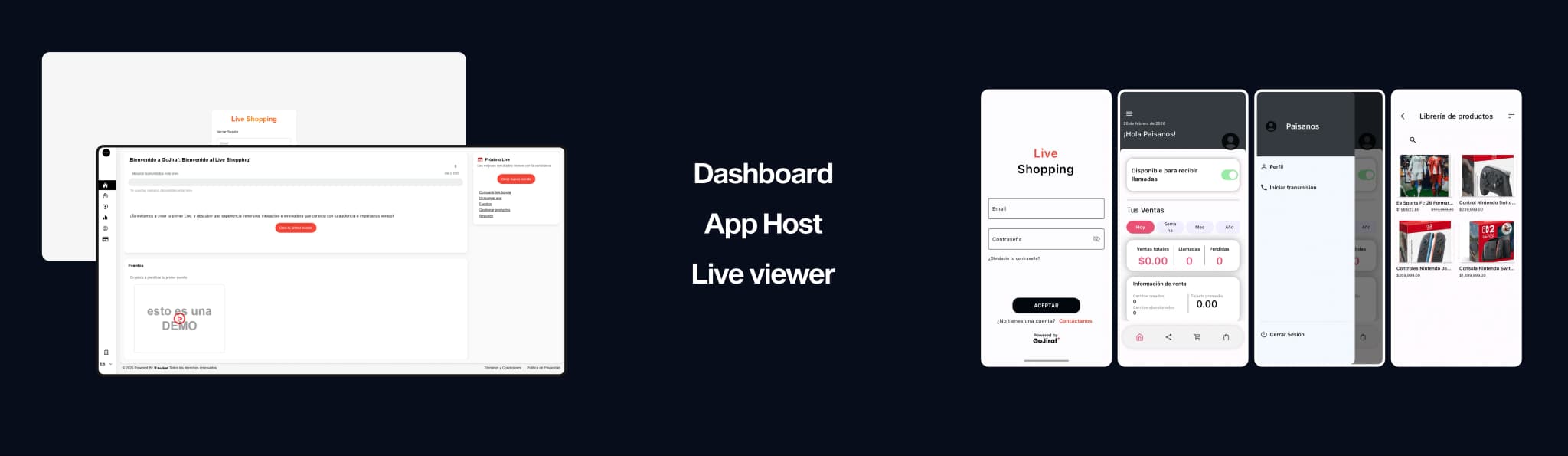
Audit. Gojiraf is a product split across different platforms, each with its own UX: the dashboard for the client user, the app for running lives, and the buyer-facing product viewer. I audited every screen of the flow, factoring in heuristics and the pain points surfaced in the interviews.
Validate. Instead of jumping straight to designing the full autonomous product, I prototyped a controlled experiment to test the main hypothesis before building it.
Listen first
Interviews with five internal roles (product, business, marketing, tech, sales) and real users from three countries (Colombia, Uruguay, and Argentina). Not to collect feature requests, but to understand what actually made the product valuable.
Audit everything
Dashboard, host app, and live viewer: three flows analyzed from the worst-case scenario, a user landing alone, with no human onboarding. What a SaaS user actually encounters when they pay for their first month.
What we found
Three insights changed how we thought about the product.
- The wow moment wasn't where everyone assumed. What won clients over wasn't opening the dashboard. It was the first guided demo, where someone from the team showed them the product with their own products on screen. That 'ah, this could work for me' moment happened on a call, not on a screen.
- The first live is the moment of truth. Retention isn't defined by the first login, it's defined by the first broadcast. If the first live doesn't convert or goes wrong, the client doesn't come back.
- Users were already using AI, just outside the product. Everyone was using ChatGPT, Claude, or Gemini to prep scripts and strategies in parallel tabs. The opportunity wasn't 'add AI', it was integrating something that was already happening.
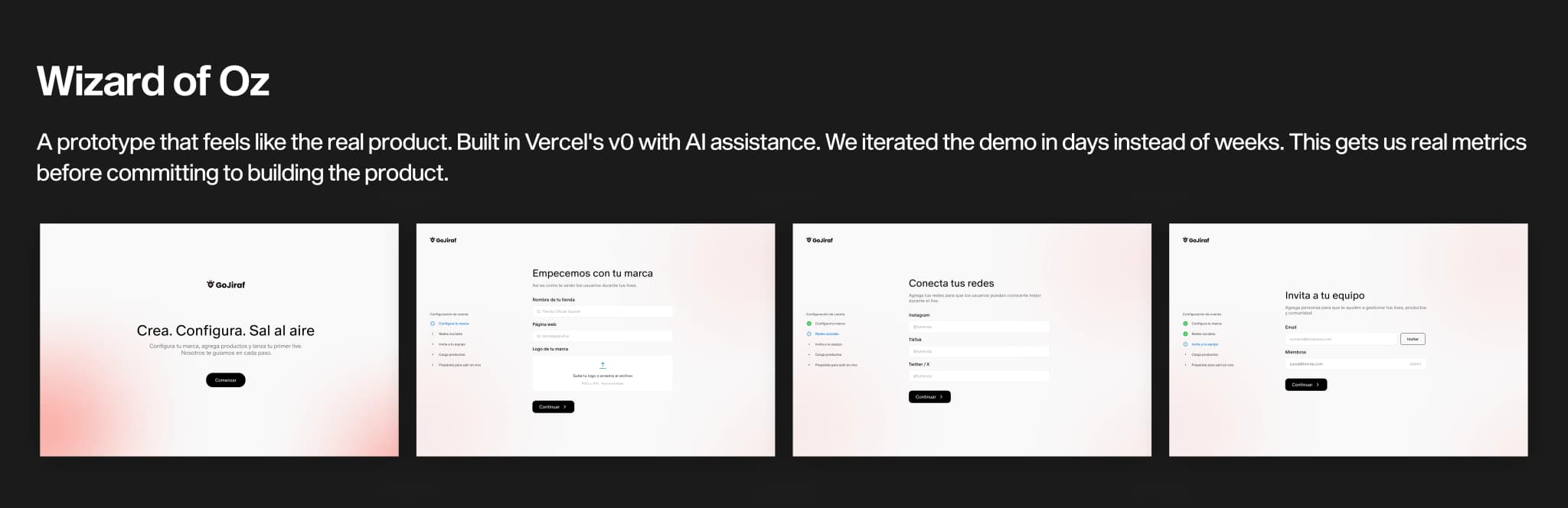
Validate before scaling
Building the full autonomous product before knowing whether the hypothesis held would have cost months of development. The alternative was a Wizard of Oz: a prototype that looks like product but carries unconfirmed assumptions behind it.
The experiment tested four things: whether an unregistered visitor could experience the wow moment on their own, whether a trial mode lowered the barrier to entry, whether a step-by-step self-onboarding with one task per screen activated new users, and whether tracking the entire flow with metrics let us measure where people dropped off.
I prototyped it in Vercel's v0, with AI-assisted code. The result was realistic enough to use for user validation and as the centerpiece of the final presentation.
Project phases
Discovery
Interviews with internal stakeholders and real users across three countries. In-depth sessions of around 50 minutes.
UX audit
Analysis of the three products (dashboard, app, viewer) assuming the worst-case scenario: a user arriving alone.
Synthesis and strategy
Prioritized hypotheses, derived outcomes, and a decision framework to guide the roadmap.
Wizard of Oz prototype
Design + build in v0 (AI-assisted). Ready for user validation and final client presentation.
Takeaways
- On model transitions. The hardest product design projects aren't the ones that redesign a screen, they're the ones that change the client's business model. Moving from service to SaaS means dismantling the human crutches that held the product up, and that doesn't get solved with UI. It gets solved by understanding what those people were doing that the product still doesn't know how to do on its own.
- On validating before building. The natural instinct at the end of a discovery is to jump straight into designing the full solution. The Wizard of Oz forces the opposite discipline: what's the most expensive hypothesis I'm about to assume, and how do I test it with the least possible work?
- On AI in the process. Prototyping with v0 changed my speed, but it didn't replace judgment. AI accelerates execution, the right questions are still the designer's job. That distinction is what turns it into a real advantage and not just a novelty.